
ABS 3-Pack
3 kg · any 3 colors
$71.70$59.00$19.67/kg
ABS filament is the plastic of LEGO bricks and car dashboards: it handles heat up to about 100°C and impacts, and you can smooth it with acetone for a glossy finish. It needs a heated bed at 90 to 110°C and an enclosed printer. If your setup is ready, our packs of 3, 6 and 10 spools lower the price of every kilogram.
 BEST SELLER
3 kg · any 3 colors
$71.70$59.00$19.67/kg
6 kg · any 6 colors
$143.40$99.00$16.50/kg
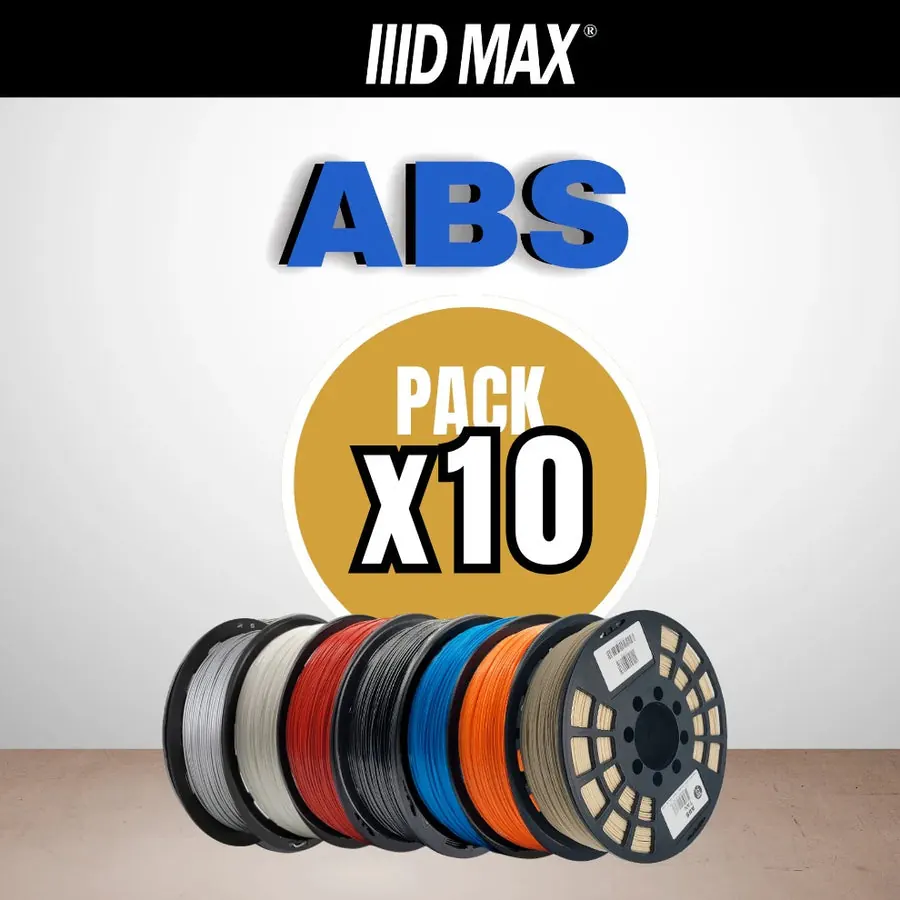
10 kg · any 10 colors
$239.00$149.90$14.99/kg
Single 0.8 kg spool · 15 colors
$25.37$31.71/kg
Buy at Supplies3D →Free shipping on filament to the lower 48 states · Ships from Miami in 1 to 2 business days · 3 to 7 business days in transit
| Spec | Detail |
|---|---|
| Material | ABS (acrylonitrile butadiene styrene) |
| Diameter | 1.75 mm ±0.02 mm |
| Spool weight | 1 kg in the packs · 0.8 kg Fremover single spool |
| Colors | Any mix from our ABS range · 15 in Fremover |
| Heat resistance | About 100°C |
| Finishing | Acetone smoothable |
| Enclosure | Required, 40 to 50°C inside |
| Ventilation | Required: ABS releases fumes while printing |
| Packaging | Each spool vacuum-sealed with desiccant |
| Shipping | Free to the lower 48 states on filament orders · ships from Miami in 1 to 2 business days |
| Returns | 30 days from delivery, unused and in its original packaging |
Heat the bed to 90 to 110°C and close the printer: ABS shrinks as it cools, and drafts make the corners lift. An enclosure keeps the air around the part warm and steady, ideally around 40 to 50°C.
Print in a ventilated room or vent the enclosure outside, because ABS releases fumes while it prints.
Both are made for functional parts. ABS wins on heat resistance and on finishing, since acetone vapor leaves it smooth and glossy. PETG is easier: no enclosure and almost no warping.
If you do not have an enclosed printer, start with PETG. If you print housings or parts near motors and heat, ABS is the better fit.
Warping, the corners lifting off the bed, is almost always cold air reaching the part. Close the printer, turn the part cooling fan off for the whole print and keep the bed at around 100°C.
A PEI sheet gives the best grip. If you do not have an enclosure yet, even a cardboard box over the printer cuts the drafts that cause most failed prints.
Printing a little slower, 40 to 60 mm/s, also helps: each layer has more time to bond to the one below.
Shops that print ABS every day burn through spools fast. A pack keeps your main colors in stock and lowers the price per kilogram, and all the spools arrive vacuum-sealed with desiccant.
Acetone vapor melts the outer skin of an ABS part and leaves it smooth and glossy, hiding layer lines. Most makers place the part in a closed container with a little acetone on a paper towel and check it every few minutes.
Do it outdoors or in a well ventilated room, far from any flame or heater, because acetone fumes are flammable. Let the part rest until it is fully hard again before handling it.
Electronics housings, car interior clips, brackets near motors, tool handles and anything that will sit in the sun or near heat. If the part only needs to look good on a shelf, PLA+ is cheaper and easier to print.
Manufacturer starting points. ABS punishes drafts more than wrong temperatures.
| Setting | Range | Where to start |
|---|---|---|
| Nozzle temperature | 230 to 250°C | 240°C |
| Bed temperature | 90 to 110°C | 100°C on PEI |
| Enclosure | Required for large parts | 40 to 50°C inside |
| Cooling fan | Off | For the whole print |
| Print speed | 40 to 60 mm/s | Slower for tall parts |
| Retraction | Direct drive 2 to 3 mm, Bowden 4 to 6 mm | At 30 to 50 mm/s |
| Drying | 60 to 65°C for 4 to 6 hours | If you hear popping or see a rough surface |
| Diameter | 1.75 mm ±0.02 mm | Standard 1.75 mm printers |
One that comes dry and keeps a consistent diameter. Our ABS spools are 1.75 mm ±0.02 mm and arrive vacuum-sealed, so they print the same from the first meter to the last.
A nozzle at 240°C, a bed at 100°C, the fan off and an enclosed printer with good ventilation. Without an enclosure, large ABS parts tend to warp.
No. ABS resists more heat and can be smoothed with acetone, while PETG is easier to print and does not need an enclosure.
Not usually. Start with PLA+ or PETG and move to ABS once your printer is enclosed.
Only if it has absorbed moisture: popping sounds or a rough surface are the signs. Dry it at 60 to 65°C for 4 to 6 hours.
Pick your pack, choose your colors and get free shipping to the lower 48 states.