
TPU 95A 3-Pack
3 kg · any 3 colors
$68.97$67.17$22.39/kg
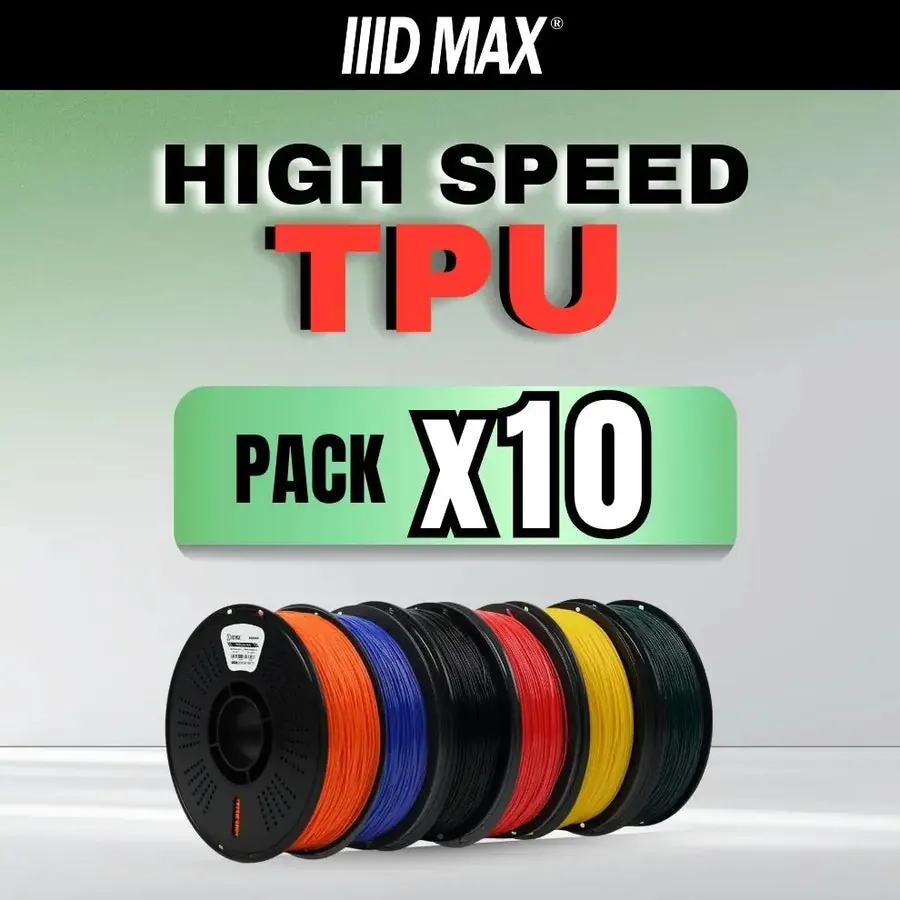
TPU filament prints parts that bend and spring back like rubber. The 95A hardness is flexible enough for phone cases, gaskets and grips, yet firm enough to print on most direct drive printers. Buy it in packs of 3, 6 or 10 spools and choose every color.
 BEST SELLER
3 kg · any 3 colors
$68.97$67.17$22.39/kg
6 kg · any 6 colors
$146.40$24.40/kg
Buy at Supplies3D →10 kg · any 10 colors
$229.90$198.80$19.88/kg
Free shipping on filament to the lower 48 states · Ships from Miami in 1 to 2 business days · 3 to 7 business days in transit
| Spec | Detail |
|---|---|
| Material | TPU (thermoplastic polyurethane), flexible |
| Diameter | 1.75 mm ±0.02 mm |
| Hardness | Shore 95A |
| Spool weight | 1 kg (2.2 lbs) |
| Colors | Any mix from our TPU range |
| Extruder | Direct drive recommended; Bowden works slowly |
| Print speed | 25 to 50 mm/s to start on direct drive |
| Batch | Every spool in a pack from the same manufacturing batch |
| Packaging | Each spool vacuum-sealed with desiccant |
| Shipping | Free to the lower 48 states on filament orders · ships from Miami in 1 to 2 business days |
| Returns | 30 days from delivery, unused and in its original packaging |
Flexible filament needs a short, controlled path from the gear to the nozzle. On a direct drive printer such as a Bambu Lab, a Prusa MK4 or a Voron, our TPU prints cleanly at around 40 to 60 mm/s.
On a Bowden printer like a stock Ender 3 or CR-10 it still prints, but slowly: keep it around 15 to 20 mm/s.
Phone and tablet cases, watch straps, cable organizers, drone bumpers, seals, feet for furniture and anything that should absorb a hit.
Because each pack lets you choose the colors, you can match the cases and grips you sell to your customers' requests.
Two settings work the opposite way from rigid filaments. Retraction has to be much shorter, because a long pull stretches the soft filament and jams the extruder. The part cooling fan should also run lower than with PLA, so layers have time to fuse.
Do not load your PLA profile and hope for the best: start from the settings below and change one thing at a time.
A clicking extruder means you are printing too fast for the filament to keep up; slow down 5 mm/s at a time. Stringing usually goes away by lowering the nozzle 5°C, and bubbles or a rough surface point to a wet spool.
TPU grips the bed hard, so let the plate cool completely before you remove a print. On repeated production runs a thin layer of glue stick makes release easier.
In TPU, the print settings decide how soft the part feels. Fewer walls and a low infill give a squishy, flexible part; more walls and a denser infill make it firm and tough.
Keep walls at least two lines thick so the part does not tear, round sharp inside corners, and test one small piece before printing a full batch of cases or gaskets for a customer.
The 3-pack is the low-risk way to try three colors at batch pricing. The 6-pack and the 10-pack suit shops that print flexible parts every week, and every spool in a pack comes from the same manufacturing batch, so color and feel match from one print to the next.
| Printer | Examples | Print speed with this TPU |
|---|---|---|
| Direct drive | Bambu Lab, Prusa MK4, Voron | About 25 to 50 mm/s to start, up to 60 mm/s tuned |
| Bowden | Stock Ender 3, CR-10 | About 15 to 20 mm/s |
Manufacturer starting points. TPU has a narrow window: stay within 10°C of your target.
| Setting | Range | Where to start |
|---|---|---|
| Nozzle temperature | 220 to 235°C | 225°C |
| Bed temperature | 40 to 60°C | 50°C on PEI |
| First layer | Always slow | Let it settle into the bed |
| Retraction | Much shorter than PLA | Start low and raise only if it strings |
| Cooling fan | Lower than PLA | Helps layers fuse |
| Diameter | 1.75 mm ±0.02 mm | Standard 1.75 mm printers |
Yes. TPU is a flexible 3D printing filament, a thermoplastic polyurethane that behaves like rubber once printed.
Cases, gaskets, grips, straps, bumpers and other parts that need to bend without breaking.
It can, but slowly, around 15 to 20 mm/s. A direct drive extruder gives faster and more reliable results.
It is the Shore hardness. 95A is a common flexible grade: soft enough to bend and firm enough to feed reliably.
You are pushing the filament faster than it can feed. Lower the speed 5 mm/s at a time until the clicking stops.
Pick your pack, choose your colors and get free shipping to the lower 48 states.